
The global market for Automated Guided Vehicles (AGVs) is surging as facilities rush to replace manual transit routes with predictable, robotic workflows. The glossy marketing brochures present a flawless vision: a pristine, frictionless facility where machines seamlessly glide into place and immediately boost throughput.
Then, deployment day arrives.
The software behaves perfectly. The sensors are calibrated. But when the AGV approaches your existing fleet of manual tow carts, you discover the hitch mechanisms miss each other by two inches. Or your custom parts bins require a non-standard mounting bracket that doesn't exist in the vendor’s catalog.
At this precise moment, most legacy automation vendors pull out their contracts, point to the fine print, and say, "Not our problem. Call a local fabricator and let us know when your infrastructure is ready."
This passing of the buck is where multi-million dollar automation deployments go to die. It kills implementation timelines, introduces unbudgeted engineering costs, and leaves capital equipment sitting idle on the floor. In short, it's a living nightmare.
In the rush to automate, the material handling industry has developed a massive blind spot. We have treated automation primarily as a software and electronics challenge. We optimize the algorithms, the fleet management systems, and the lidar arrays, while completely ignoring the basic laws of mechanical physics.
If an automated vehicle cannot physically secure, lift, or tow the payload due to a geometric mismatch, the intelligence of the software layer becomes entirely irrelevant.
When facilities are confronted with this mismatch, they are typically forced into two equally toxic options:
This exact physical vulnerability played out recently during a fleet deployment. A high-throughput manufacturing facility invested in an RG Robotix AGV fleet to automate internal logistics transit routes. While the digital integration was flawless, the physical floor reality was not. Simply put, the client wanted the AGV fleet to be able to autonomously hitch and couple to some of their existing manual carts to tow them across the facility.
Sounds simple, right? Ah, but the devil is in the details.
Standard, off-the-shelf AGV hitch components could not interface with the legacy carts automatically. Furthermore, the environment demanded a fail-safe safety hitch. Because automatic coupling involves blind, mechanical mating forces, the hitch had to guarantee a positive lock while completely eliminating catastrophic pinch-points—ensuring floor operators couldn't get their hands or fingers crushed if they happened to be near the docking zone.
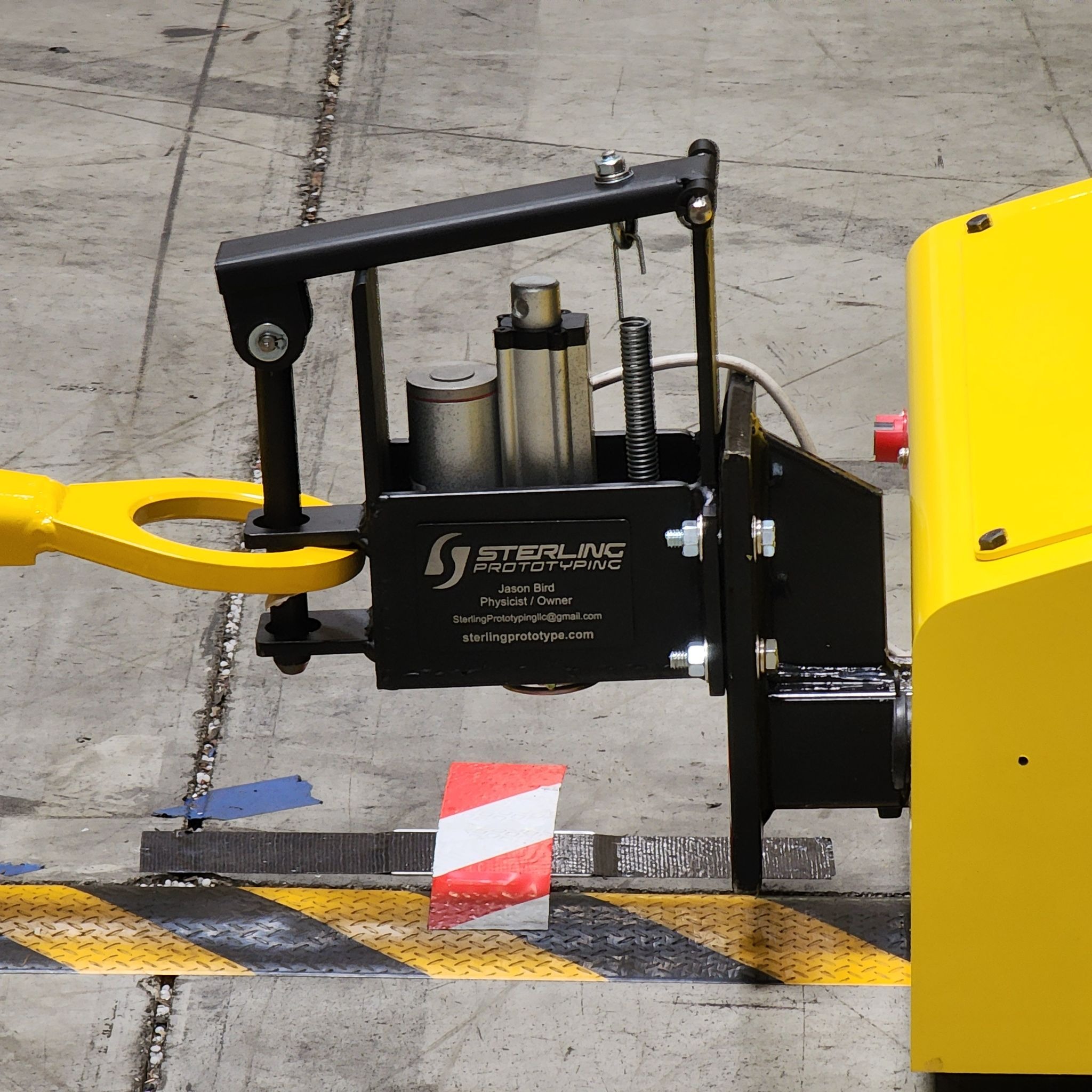
Instead of walking away or demanding a costly infrastructure overhaul, RG Robotix deployed a unified hardware-software approach, bringing in Sterling Prototyping (dba Sterling Product Development) to engineer the physical mechanics required for autonomous, fail-safe, and finger-safe coupling.
By treating the physical mismatch as a core engineering parameter rather than an administrative roadblock, the team executed a high-velocity, robust engineering and rectification process:
Automation does not exist in a digital vacuum. It exists on a concrete floor filled with warped metal, mismatched tolerances, and decades of legacy infrastructure. If your automation vendor cannot solve the literal, physical mechanics of your environment, your deployment will fail.
Through the strategic relationship between RG Robotix and Sterling Prototyping, we eliminate the divide between software execution and physical reality. We don’t just drop hardware at your dock and wish you luck. We deliver a fully integrated, functional system—even if we have to invent a new mechanical component to bridge the gap.
Stop waiting for your physical facility to become "perfect" enough for automation. Let’s engineer the solution to match the floor you actually have.
.png)

.png)
